


Eric Draitser of StopImperialism.com appears on RT's CrossTalk to discuss the state of the US economy, specifically the assault on working people and the poor. Eric explains how low wage jobs have been used as a weapon by the ruling class to convert the US economy from a high wage economy to one that is typified by low wages, temporary jobs, and a reduced standard of living. Eric also examines many other aspects of this issue in this half hour program.
Tuesday, 30 July 2013
Monday, 29 July 2013

Russia Today
Ties between Washington and Moscow are at their lowest point in recent times, but if the United States truly wishes for better relations with Russia, it isn’t going to get it through imposing sanctions as a consequence of granting amnesty to NSA whistleblower Edward Snowden.
The US Senate has passed a bill authored by hawkish Senator Lindsey Graham that will enable Washington to move towards sanctioning countries that are seen as “aiding” Snowden. The message being sent is clear – American authorities are dead set on getting their “fugitive” and they are even willing to take the unprecedented move to impose sanctions on other countries for their failure to extradite a US citizen. Such a move completely undermines an individual’s right of asylum as specified by international law, and is a deeply hypocritical stance for a country that loves to posture itself as an arbiter of righteousness and a haven for asylum seekers and dissidents. During his speech to the Senate Appropriations Committee, Graham went on an anti-Russian tirade and made clear Putin’s administration will be in the thick of the proposed sanctioning effort. Such is the folly of US policy, which aims to get others to comply with little in return, or face punishment of sanctions. To add insult to injury, Moscow knows that the US would never concede to the demands it is currently placing on Russia if the tables were turned.
Nile Bowie is a Malaysia-based political analyst and a columnist with Russia Today. He also contributes to PressTV, Global Research, and CounterPunch. He can be reached at nilebowie@gmail.com.
Saturday, 20 July 2013

Mahdi Darius Nazemroaya
Despite the fact that Prime Minister Erdogan denounced Tel Aviv for attacking Syria, the first fruits of Israeli and Turkish collaboration became visible in May 2013 when Israeli warplanes attacked a Syrian military research facility in the town of Jamraya with US approval, as admitted by President Obama to Telemundo. Right after the Israeli attacks the Turkish and Israeli militaries launched simultaneous exercises on their respective borders with Syria. Although the military operations were presented as uncoordinated events, both Ankara and Tel Aviv were coordinating with one another in a military posture against Syria. The Israeli and Turkish moves on their borders with Syria were probably aimed at preventing Syria from responding through intimidation. The Turkish government would also put extra pressure on the Syrians by blaming them for a terrorist attack in the Turkish border town of Reyhanli, which the Turkish activist group of internet hackers named Redhack would be revealed was known about well in advance by Turkey’s Gendarmerie Intelligence.
Mahdi Darius Nazemroaya is a sociologist, award-winning author, and noted geopolitical analyst
Wednesday, 17 July 2013

Nile Bowie
Political polarization has reached new heights in Egypt following the dramatic overthrow of Mohamed Morsi, the country’s first democratically elected leader. Recent polls taken before the June 30 protests showed that SCAF’s approval rating had reached 94 percent while the Muslim Brotherhood’s rating was at 28 percent and the opposition’s at 38 percent. It’s strange that Egypt’s anti-Morsi activists would place their trust in SCAF given its extensive crackdown on civilian protesters since the revolution began, and certainly no one can deny that the Muslim Brotherhood was isolated during its final days. It is highly unlikely that Morsi would ever be reinstated at this point, and the interim government can be expected to pursue austerity measures, economic restructuring, and a foreign policy in step with Western-Gulf states. Morsi had something that the current rulers of Egypt do not – democratic legitimacy – and despite that only 34 percent of Egyptians took part in the vote, the result should have been respected by the military. Morsi was by no means a democrat, but the Muslim Brotherhood captured the majority in parliament, and their persecution and total exclusion from the interim government is unacceptable.
After sweeping away two presidents since 2011, the original goals of the revolution, embodied in the popular slogan “Bread, Freedom, Social Justice and Human Dignity,” haven’t come close to materializing. For all intents and purposes, life for the average Egyptian is more difficult now than under Hosni Mubarak, and although Morsi’s shortcomings may not have justified a military coup, his tenure was a spectacular failure. Although many perceive Morsi and Egypt’s Supreme Council of the Armed Forces (SCAF) as being hijackers of the 2011 revolution, the bottom line is that the revolutionary fervor emanating from Tahrir Square is not directed against one party or political figure, but against economic conditions and neo-liberal tendencies that have largely remained unchanged throughout the ebb and flow of Egyptian politics in recent times.
Nile Bowie is a Malaysia-based political analyst and a columnist with Russia Today. He also contributes to PressTV, Global Research, and CounterPunch. He can be reached at nilebowie@gmail.com.
Tuesday, 16 July 2013
Eric Draitser
StopImperialism.com
 Zimbabwe’s upcoming elections, scheduled to take place on July 31st, will go a long way to determining the future of the country. On the one hand, the entrenched power of President Mugabe and ZANU-PF enters the elections with a track record that both elicits praise and inspires criticism. On the other hand, there is Prime Minister Morgan Tsvangirai and his opposition Movement for Democratic Change (MDC) which enters the election once again with the high-minded rhetoric of “democracy” and “transparency”, but also with a mixed record that has many questioning their ability to lead.
StopImperialism.com
Zimbabwe’s upcoming elections, scheduled to take place on July 31st, will go a long way to determining the future of the country. On the one hand, the entrenched power of President Mugabe and ZANU-PF enters the elections with a track record that both elicits praise and inspires criticism. On the other hand, there is Prime Minister Morgan Tsvangirai and his opposition Movement for Democratic Change (MDC) which enters the election once again with the high-minded rhetoric of “democracy” and “transparency”, but also with a mixed record that has many questioning their ability to lead.With less than two weeks to go before Zimbabweans go to the polls many questions remain unanswered: Will the MDC-T boycott the elections due to what they perceive to be a lack of reforms? Will Zimbabwe be able to carry out peaceful elections, unlike in 2008? Are the people of Zimbabwe satisfied with the progress of land redistribution and other reforms implemented by Mugabe and ZANU-PF? These are only some of the most pressing questions weighing on the minds of urban and rural Zimbabweans alike.
Elections: An Economic Referendum
Since the creation of the ZANU-PF/MDC-T inclusive government after the election in 2008, there has been a marked change in Zimbabwean politics. No longer is ZANU-PF the sole party in power and, consequently, the sole party responsible for positive and negative policy outcomes. Rather, both parties’ respective leaders enter this year’s elections as incumbents, and both must face scrutiny over their policies and their actions.
President Mugabe and ZANU-PF have a difficult fight ahead of them. Despite outside factors such as sanctions imposed by the US and UK, many Zimbabweans hold Mugabe and ZANU-PF responsible for the economic difficulties of the recent past including record inflation which led to the collapse of the currency and its abolition in favor of the US dollar. The African Development Bank’s Economic Outlook for Zimbabwe, published in 2011, notes that, “Inflation is projected to rise to 6.5% in 2012 and 6.7% in 2013. Inflationary developments in the short to medium term will continue to be influenced by the US dollar/rand exchange rate, inflation developments in South Africa, international oil prices, and local utility charges.”[i] By adopting the US dollar, Zimbabwe managed to resolve the crippling plague of inflation, though at the cost of any semblance of monetary sovereignty.
Unemployment continues to be one of the principal concerns, particularly among young people, many of whom fear that any hope for the future is little more than idle daydreaming. According to the Reserve Bank of Zimbabwe, the unemployment rate as measured in January 2012 was 10.7%. However, it must be noted that these numbers, like unemployment rates in the United States, are likely to be a gross underestimation as they only consider those actively searching for work as a percentage of the labor force. Essentially then, the many Zimbabweans who are officially unemployed but not “actively looking for work” disappear in these statistics.
According to the CIA World Fact Book, as well as a number of international NGOs, Zimbabwe’s true unemployment rate is one of the highest in the world, with estimates ranging from 50% to as high as 95%. However, these too are likely to be distorted numbers which do not take into account the informal economy and the many forms of economic activity that do not have a place in the official statistics. Moreover, such inflated data is rooted in the West’s ideological and political desire to demonize ZANU-PF and foment political upheaval. As Zimbabwe’s MDC-T Finance Minister Tendai Biti explainedin June 2013:
We have always had this argument about what is the percentage of people that are employed or unemployed in Zimbabwe. Textbook economists will say 85 percent but that is not true. If we had a population like that, most people in Zimbabwe would have died, it is not possible…One is either a farmer, selling juice cards, driving an emergency taxi, or working as a hair dresser. The fact of the matter is most people are economically active.[ii]
Biti’s point is a valid one. To simply claim that all those people employed in the informal economy are somehow unemployed is pure dishonesty. However, the Reserve Bank of Zimbabwe’s unemployment figure of less than 11% is also an exercise in spin. The true unemployment is somewhere between these two extremes. However, no matter the actual figure, unemployment continues to be one of the most pressing issues on the minds of Zimbabweans.
Unlike inflation and unemployment – problems faced by all countries regardless of development – there are two particular economic programs which are specific to Zimbabwe and have a tremendous impact on the lives of its citizens: Land redistribution and “indigenization”. The common thread linking these two programs is the creation of a self-sufficient and economically independent nation.
An inescapable outcome of European colonial control and imperialism has been the dispossession of black Africans. By the end of the liberation struggle, the vast majority of arable land was in the hands of white farmers while the black population worked the land in the service of the European landowners. However, by 2000, Mugabe and ZANU-PF began the “fast track” land program. The results of this program are discussed in the new book Zimbabwe Takes Back Its Land. The authors explain:
In the biggest land reform in Africa, 6,000 white farmers have been replaced by 245,000 Zimbabwean farmers. These are primarily ordinary poor people who have become more productive farmers. The change was inevitably disruptive at first, but production is increasing rapidly. Agricultural production is now returning to the 1990s level, and resettled farmers already grow 40% of the country’s tobacco and 49% of its maize.[iii]
It should be acknowledged that the actual distribution of this land was not without problems and corruption, as some of the best land was seized by force and through cronyism. However, despite this corruption (a droning talking point in the mainstream media in the West who attempt to demonize Mugabe at every turn), the results of the program are undeniable: Africa’s greatest land redistribution program has created a new class of farmers forming the backbone of Zimbabwe’s agricultural output, and its economy.
Like the land reforms implemented by Mugabe and ZANU-PF, the “indigenization” program is also designed to increase self-sufficiency and independence from foreign control. The indigenization program altered the laws of the country in regards to ownership, mandating that enterprises deemed in the national interest should be majority owned by Zimbabweans, not foreign investors, be they white or black. Though the program was initially mocked, and continues to be met with derision by capitalists the world over, it has proven to be successful, at least in the early stages. The indigenization program also is intended to address unemployment, and specifically youth unemployment which continues to be a major problem.
These economic issues are fundamental to the daily lives of regular Zimbabweans. As such, they will undoubtedly be the issues that impact, more than anything else, how Zimbabwe votes. However, although economics is on the minds of everyone, politics have shaped the debate. Unlike in 2008, when Morgan Tsvangirai and the MDC-T were merely the opposition with no political power, this time around they have to defend their record on all of the economic policies and more. Likewise, ZANU-PF has a number of significant political questions to address as it tries to convince Zimbabweans to continue their commitment and support for Mugabe and the revolution.
The Politics of Progress
Both major parties in Zimbabwe are attempting to present themselves as reformers interested in progressive change that will improve the lives of working people and the poor. However, ZANU-PF and MDC-T employ very different strategies – policy, rhetoric, ideology, etc. – in order to achieve substantive positive change. While Mugabe and ZANU-PF tout their tremendous achievements with land redistribution, indigenization and nationalization, and other nationalistic policies, Tsvangirai and the MDC-T rely on the more abstract concepts of democracy, transparency and anti-corruption, and integration with the world economy, specifically with the Western powers. These radically different approaches present Zimbabweans with a very important choice in these elections.
Prime Minister Morgan Tsvagirai has long since been correctly understood to be the favored choice of the US and UK. His MDC-T has advocated tirelessly for economic policies that are geared towards international economic integration, while blasting all economic policies put forward by ZANU-PF. Additionally, many Zimbabweans have begun asking precisely what role the MDC-T has played in the economic assault on the country through sanctions. In an op-ed piece in the New Zimbabwe, Tobaiwa Tigere states, “A key reason why ZDERA [Zimbabwe Democracy and Recovery Act] was passed was to enable to US Secretary of the Treasury to transfer funds from the US to Zimbabwe to ‘aid democratic forces in that country’…some estimates put the dollar value of resources transferred to the MDC-T since ZDERA was enacted at well over $250 million.”[iv] Additionally, one should also recall the WikiLeaksdocuments which “Showed that he [Tsvangirai] had been privately urging Washington to maintain sanctions against Harare, while taking the opposite position in public.”[v] Such facts raise doubts in the minds of many Zimbabweans who are understandably dissatisfied due to poverty and unemployment, but who likewise understand that an MDC-T victory is a victory for Washington, London and Wall St.
Naturally, the amount of overt and covert support the MDC-T has received from the US and other Western powers has caused many to wonder what exactly is the on the agenda of the MDC-T and its backers. The question of regime change, the favorite tactic of western imperialism in the 21st Century, is very much out in the open. In fact, President Mugabe addressed this very point in a recent interview. Speaking about the need for these elections, Mugabe stated:
We had to demonstrate to the West that it’s not you who should instruct us to stand down, ha, regime change does not work. Who are you to want our regime to change?...But we said no, we fought them yesterday you see, we can fight them again. We won’t collapse and we didn’t collapse, we will remain and remain with the leadership they don’t want…We’re defiant…But we will settle down and naturally we should allow power to transfer. But we must be assured that when we transfer that we are well united and we have built-in strength within the party.[vi]
Here, one can see clearly the juxtaposition that is at the heart of these elections: Mugabe and ZANU-PF’s defiance of the western powers and their neocolonial agenda, and Tsvangirai and MDC-T’s embrace of the neoliberal capitalist ideology as evidenced by their inextricable link to Western finance and intelligence.
Tsvangirai and the MDC-T have stated repeatedly that, despite taking part in the elections, they are not convinced of their fairness. They have publicly proclaimed that, without the necessary reforms taking place (media, security, and electoral reforms), the election will be irrelevant. Deputy Prime Minister and MDC Vice President Thokazani Kupe explained in a recent interview that, “As the MDC we are prepared for election anytime but as long as all these [reforms] are done before July 31 we don’t have any problems. But there is no way we can [stand] for an election without these things being done, it will be a waste of time.”[vii] Such comments merit closer analysis. On the one hand, it seems that MDC makes an important point that, in order to have truly fair elections, the playing field must be leveled. However, seen from another perspective, this is a cynical ploy utilized by the MDC in order to protect itself against electoral defeat. By establishing the elections as “fair” only if the conditions laid out by MDC are met, Tsvangirai’s party effectively invalidates the election prima facie or, to put it another way, the MDC invalidates the elections…unless they win.
The MDC has built its reputation criticizing ZANU-PF and Mugabe. The party has managed to win over millions of Zimbabweans who, out of economic desperation, are willing to listen to anyone offering the hope of a better future. However, when examined from a purely policy perspective, it becomes clear that MDC and Prime Minister Tsvangirai have many questions to answer. First and foremost, the opposition has to explain to working people why it is that the MDC-T has always sided with the financiers and neoliberals: they opposed Mugabe’s land programs, opposed the indigenization program, opposed the mine nationalization program, and much more. Although these programs were not without their faults, taken as a whole, they have proven to be successful and have been supported by the people. Many Zimbabweans wonder why Tsvangirai always seems to side with the US and the British speculators and financiers. They are right to wonder.
The rhetoric employed by Tsvangirai and the MDC is critical. They call for “reform”, “change”, “transparency” and many other buzz words of modern democracy. However, the real question before Zimbabweans is, to what extent are these slogans merely the window-dressing for opening up the country to vulture capitalists and speculators who will be able to profit off of Zimbabwe’s resources without sharing the profits with the people? In this way, MDC-T has a very serious image problem: they are seen as puppets of the West. Not only does this have implications for the economic future of the people and the country, but its political future as well.
The United States has spent the last few years building its military capacity all throughout the African continent. The establishment and expansion of US Africa Command (AFRICOM) has entrenched US military “advisors” throughout the militaries of the continent, while drone bases like those in Djibouti and Niger greatly expand US military capacity on the continent. Additionally, considering their domination of the African Union, ECOWAS, and other regional groupings, the United States has cemented a dominant position in Africa. Yet, despite all the difficulties, Zimbabwe remains untouched by US imperial presence. How long will such a status quo last if Tsvangirai and MDC claim power?
As Election Day approaches, all of the most pressing issues facing Zimbabweans will come to the fore. It against the tumultuous political and economic backdrop of life in that country that the people will make their voices heard. However, the elections are more than simply a choice between two political formations. Rather, the elections represent the continuation of the revolution and the liberation struggle. The heroes who died for Zimbabwe made the ultimate sacrifice so that the people would be able to determine their own future, not white European capitalists. It is upon the ground where they shed their blood for the people, that the people will cast their votes and decide their future.
Eric Draitser is the founder of StopImperialism.com. He is an independent geopolitical analyst based in New York City. You can reach him at ericdraitser@gmail.com.
Saturday, 13 July 2013

The Vienna Convention on Diplomatic Relations is the international treaty that forms the legal basis for diplomatic immunity. But on July 2ndthe aforementioned NATO countries, most likely led by the US, breached the Convention by colluding to disallow a Bolivian presidential flight into their respective airspace. This was allegedly based on the unfounded suspicion that the flight was transporting US National Security Agency whistleblower Edward Snowden. President Morales and accompanying Bolivian officials were returning to Bolivia after attending a Forum of Gas Exporting Countries in Russia. Low on fuel, due to rerouting caused by denial of passage through the airspace of the European culprit countries, the Bolivian presidential flight had to make an emergency landing in Vienna, Austria.
This is another one of countless arrogant racist double standards that the US and its NATO allies have demonstrated since the dawn of colonialism and neo-colonialism. The Convention on Diplomatic Relations is supposed to be the framework governing relations between independent countries. It specifies the privileges of a diplomatic mission that enable diplomats to perform their functions without fear of coercion or harassment by hosts countries, including free and safe passage via land, sea or air.
While the plane was parked in Vienna, according to President Morales, the Spanish ambassador to Austria arrived with two embassy personnel and asked to search the plane. [1] Admirably exercising an understanding of his sovereign rights as a national official, the indigenous South American leader denied them access and asserted from Vienna Airport, “We won’t be threatened. We are a small country but one with dignity. I say to the European countries, we are not in times of colonization and we won’t be intimidated. This is the time of the peoples.” [2]
Despite the displeasure of European leaders over the disclosure that their US ally has been spying on them as well, their past colonial ties and neo-colonial present remain unquestionably intact.
Like a parent/child relationship, trade between other continents with the US and the EU do not enjoy such talks. But US-EU talks and their agreements can impinge on the rest of the world because of the 66 year old colonial legacy of the General Agreement on Tariffs and Trade (GATT), still in effect under the framework of the World Trade Organization. These talks allow the US and EU to make plans and decisions on how they will manage their trade interactions with everyone else.
Tolerating being spied on by each other is a small tradeoff for global economic and political dominance over the rest of the oppressed, repressed, and suffering majority of the world. There is no question that these nations would never have committed the same offense against an aircraft of one of their own. Nor do they ever have to add to their national security concerns being military invaded, the overthrow of their governments, or being subjected to economic sanctions. Lack of these concerns is a luxury non-NATO nations cannot afford.
Exercising the right of any sovereign nation, Venezuela, Bolivia and Nicaragua affirmed that, given a formal application, they would consider without question the human right of Edward Snowden to seek asylum. In contrast to how revealed US surveillance practices have affected relations among those who preside over neo-colonialism, the US feels free to threaten Latin American countries with coercive economic measures if they help Snowden. House Intelligence Committee Chairman Mike Rogers told CNN he “absolutely” thinks that one of the 15+ countries to which Snowden applied for asylum will give him travel documents and says the U.S. should look at trade agreements with the nations that are offering asylum “to send a very clear message that we won’t put up with this kind of behavior.”
As the subservience of Latin American states is fast dissolving, US woof tickets are falling on deaf ears. Instead, this act of imperialist aggression against Bolivia has sparked outrage and condemnations from the leadership and populace of several Latin American countries. Both UNASUR (Union of South American Nations) and ALBA (Bolivarian Alliance for the Peoples of Our America) called emergency meetings to address what top representative of the OAS denounced as “… total disrespect to the highest authority of a country.”
Selfless acts like those of Bradley Manning and Edward Snowden that expose US corruption and atrocities will always throw the US into a tizzy. As US public response to such corruption and atrocities meets global indignation, legitimate stances like that of Latin America will ripple into transcontinental expression. Africa too will renew and reinforce its proud legacy of bottom up struggle and smile in a new era of strength from unity, and prosperity and power from Pan-African self-determination.
Netfa Freeman is a long-time social justice activist who co-produces and co-hosts Radio WPFW 89.3 FM. He is program director and event coordinator at the Institute for Policy Studies, and aBoard member of Empower DC and on the advisory Board of MOMIES Tlc.
This is another one of countless arrogant racist double standards that the US and its NATO allies have demonstrated since the dawn of colonialism and neo-colonialism. The Convention on Diplomatic Relations is supposed to be the framework governing relations between independent countries. It specifies the privileges of a diplomatic mission that enable diplomats to perform their functions without fear of coercion or harassment by hosts countries, including free and safe passage via land, sea or air.
While the plane was parked in Vienna, according to President Morales, the Spanish ambassador to Austria arrived with two embassy personnel and asked to search the plane. [1] Admirably exercising an understanding of his sovereign rights as a national official, the indigenous South American leader denied them access and asserted from Vienna Airport, “We won’t be threatened. We are a small country but one with dignity. I say to the European countries, we are not in times of colonization and we won’t be intimidated. This is the time of the peoples.” [2]
Despite the displeasure of European leaders over the disclosure that their US ally has been spying on them as well, their past colonial ties and neo-colonial present remain unquestionably intact.
“A working group of intelligence experts from the EU member states is supposed to discuss with US counterparts allegations that the US spied on the EU and member states’ embassies in Washington, DC and New York and on the offices in Brussels of the Council of Ministers and the European Council.” [3]Regardless, the previously scheduled US-EU trade-talks in Washington DC are going forward.
Like a parent/child relationship, trade between other continents with the US and the EU do not enjoy such talks. But US-EU talks and their agreements can impinge on the rest of the world because of the 66 year old colonial legacy of the General Agreement on Tariffs and Trade (GATT), still in effect under the framework of the World Trade Organization. These talks allow the US and EU to make plans and decisions on how they will manage their trade interactions with everyone else.
Tolerating being spied on by each other is a small tradeoff for global economic and political dominance over the rest of the oppressed, repressed, and suffering majority of the world. There is no question that these nations would never have committed the same offense against an aircraft of one of their own. Nor do they ever have to add to their national security concerns being military invaded, the overthrow of their governments, or being subjected to economic sanctions. Lack of these concerns is a luxury non-NATO nations cannot afford.
Exercising the right of any sovereign nation, Venezuela, Bolivia and Nicaragua affirmed that, given a formal application, they would consider without question the human right of Edward Snowden to seek asylum. In contrast to how revealed US surveillance practices have affected relations among those who preside over neo-colonialism, the US feels free to threaten Latin American countries with coercive economic measures if they help Snowden. House Intelligence Committee Chairman Mike Rogers told CNN he “absolutely” thinks that one of the 15+ countries to which Snowden applied for asylum will give him travel documents and says the U.S. should look at trade agreements with the nations that are offering asylum “to send a very clear message that we won’t put up with this kind of behavior.”
As the subservience of Latin American states is fast dissolving, US woof tickets are falling on deaf ears. Instead, this act of imperialist aggression against Bolivia has sparked outrage and condemnations from the leadership and populace of several Latin American countries. Both UNASUR (Union of South American Nations) and ALBA (Bolivarian Alliance for the Peoples of Our America) called emergency meetings to address what top representative of the OAS denounced as “… total disrespect to the highest authority of a country.”
Selfless acts like those of Bradley Manning and Edward Snowden that expose US corruption and atrocities will always throw the US into a tizzy. As US public response to such corruption and atrocities meets global indignation, legitimate stances like that of Latin America will ripple into transcontinental expression. Africa too will renew and reinforce its proud legacy of bottom up struggle and smile in a new era of strength from unity, and prosperity and power from Pan-African self-determination.
Netfa Freeman is a long-time social justice activist who co-produces and co-hosts Radio WPFW 89.3 FM. He is program director and event coordinator at the Institute for Policy Studies, and aBoard member of Empower DC and on the advisory Board of MOMIES Tlc.
Friday, 12 July 2013

Nile Bowie
President Obama immediately cast doubt over concerns that the rebels could have been behind the attack and, despite the lack of any compelling evidence, the US concluded in June that Syrian government forces were the perpetrators. The use of chemical weapons signified the crossing of Obama’s much-touted ‘red line’ by government forces, prompting Washington to announce that it would now openly supply the rebels with arms. Meanwhile, Russia made it clear that they were not convinced by Washington’s claims as prominent Russian political figures made comparisons between Obama’s unverified claims of chemical weapons in Syria and Bush’s fabricated claims of WMDs in Iraq.
Nile Bowie is a Malaysia-based political analyst and a columnist with Russia Today. He also contributes to PressTV, Global Research, and CounterPunch. He can be reached at nilebowie@gmail.com.
Thursday, 11 July 2013
StopImperialism.com
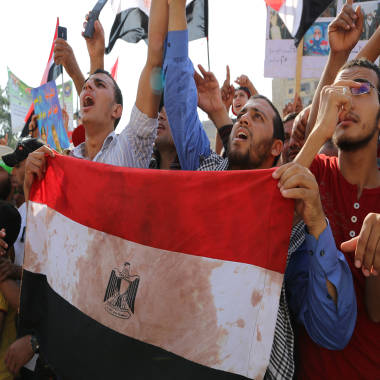
The killing of more than 50 people at a demonstration in support of ousted Egyptian President Morsi in Cairo on Monday has justifiably horrified many in Egypt and internationally. The pro-Morsi elements have placed the blame on the military forces, while the military claims it was attacked with live ammunition. While accusations are hurled back and forth, a new aspect to this story is emerging – the presence of a third force, namely snipers stationed on rooftops firing at both sides of the conflict. This revelation raises serious questions about the true nature of the conflict in Egypt and the disturbing similarities between this incident and similar ones in Syria, Thailand, and elsewhere.
The Cairo Massacre
As thousands gathered near the Republican Guard headquarters where many believe the Egyptian military is holding former President Morsi, violence erupted, killing at least 51 people and injuring hundreds. The bloody incident marked a clear transition from a purely political conflict to a potential civil war.
According to military officials, pro-Morsi “terrorists” attempted to storm the building, thereby eliciting a violent response from the military forces defending themselves. Colonel Ahmad Mohammad Ali, a spokesman for the Egyptian military claimed that police personnel were attacked while attempting to secure the area. He notedthat, “They were on top of buildings…they either fired or threw things down…they were firing live ammunition and the military had to defend itself.” Colonel Ali’s comments have been echoed by most major media outlets in Egypt which are largely controlled by forces sympathetic to the military and the former Mubarak regime. However, the Muslim Brotherhood and other pro-Morsi forces paint a distinctly different picture.
A statement on the Muslim Brotherhood’s Freedom and Justice Party website naturally blames the Egyptian military forces for wantonly killing what it describes as “peaceful protestors who reject the military coup and demand reinstatement of their elected President Mohamed Morsi.” From the Islamist perspective, the massacre, as well as the coup itself, was a direct assault not only on the Muslim Brotherhood but on democracy itself. Moreover, the killings seem to have set the precedent that Islamist elements have no recourse in Egypt other than violence.
Despite the differences between these opposing factions, there is a common thread between them – both are blaming the other for inciting the violence that could lead to a total destabilization of the country. However, here it is critical to note that the bulk of the killings on Monday took place at the hands of unknown snipers stationed on rooftops, as shown in this youtube video. Although the snipers appear to be wearing military uniforms, their actual identity remains unclear. Because it is impossible to verify exactly who the snipers were, and who they were working for, it is critical to instead examine the possible motives or lack thereof.
The military has claimed repeatedly that they were attacked and that the response was purely defensive. However, this cannot possibly explain the presence of military snipers on rooftops, no mere defensive posture. Conversely, the claim by the Muslim Brotherhood and allied supporters that the snipers were obviously Egyptian military does not seem consistent with the political circumstances, nor the facts on the ground.
First and foremost, it should be noted that the military stands nothing to gain and everything to lose from using such tactics. Having seized power in what can only be regarded as one of the most “popular coups” (not my term) in modern history, they already had the majority of the country and world opinion on their side. There was no worldwide condemnation of their actions, rather, governments seemed to be falling over themselves to “look forward” and “call for stability”, both simply coded language for tacit support. So, with the world watching Egypt, carefully scrutinizing every move the military and secular opposition make, in what possible way could they stand to benefit from sowing such chaos? Naturally, they stood to gain nothing. Moreover, the notion that Egyptian military snipers would fire at their fellow soldiers is far-fetched to say the least.
Secondly, the Muslim Brotherhood and their supporters undoubtedly understood the impossibility of fighting the military on the streets. Whatever weapons sources claim they had (bottles, rocks, small arms) are certainly not enough to significantly impact the military. The notion that these demonstrators attempted to “storm” the Republican Guard headquarters seems laughable. Although the crowd was predominantly comprised of fervent supporters of the deposed President Morsi, they were still regular Egyptians, not militant Salafists or some such formation.
So it would seem that neither side really stood to benefit or had the capability to do what the other side is suggesting. That would then raise the most critical question of all…if the snipers were not part of either side, then who exactly were they? It would seem that the only logical conclusion would be that the snipers were from some as yet unknown third party whose interest was not in taking sides but in ensuring that violent clashes and killings would take place so as to stoke tensions and foment civil war. Keen observers will note that we have seen this scenario before, most recently in Syria.
The Syrian and Thai Precedent
At the outbreak of the violence in Syria in 2011, many wondered how the situation on the ground escalated so quickly. It would seem, according to mainstream Western media reports, that the Syrian security forces had simply gone mad and began killing peaceful demonstrators at random. However, what became clear within days was the fact that unknown snipers stationed on rooftops in cities such as Deraa and Hama were indeed the main culprits. As seen in these videos as well as countless articles, the presence of snipers on rooftops throughout Syria is undeniable. Naturally, the claim was immediately made that the snipers were merely Assad’s military forces. Conveniently enough, no evidence was ever produced that showed the initial snipers were indeed government soldiers.
Interestingly, the Arab League observer mission, itself openly hostile to the Assad regime, noted in its report of early 2012 that many of the atrocities including sniper shootings, could be correctly attributed to a third, unknown force inside the country. As the reportnoted:
The Mission determined that there is an armed entity that is not mentioned in the protocol. This development on the ground can undoubtedly be attributed to the excessive use of force by Syrian government forces in response to protests that occurred before the deployment of the Mission demanding the fall of the regime. In some zones, this armed entity reacted by attacking Syrian security forces and citizens, causing the government to respond with further violence.
The report corroborates what many eyewitnesses have stated, namely that some of the violence that erupted at the outset of the conflict in Syria was attributable to this “third force” replete with snipers and military training and equipment. Predictably, the report attempts to spin the violence from the “third force” as being purely in response to the Syrian military, but provides no evidence other than a generic assertion that “undoubtedly [the violence] should be attributed to the excessive use of force by Government forces”. Essentially then, it should be clear that there was some element inside of Syria during the early stages of the conflict that used snipers and other forms of violence and terror to push the opposition and government into full scale war. It seems to have worked quite successfully.
Syria is certainly not the only country that has experienced this sort of phenomenon. In 2010, violence erupted between the government of Thailand and red shirted supporters of US-backed former Prime Minister Thaksin Shinawatra. Just as in Syria, mysterious gunmen armed with sniper rifles, machine guns, and grenades emerged within the ranks of the red shirts and began attacking Thai troops, killing a prominent Colonel and six other soldiers. The attempt to “storm” a military facility with protestors was clearly a cynically orchestrated cover for the fomenting of chaos and possible destabilization of the country with the intention of installing Washington’s darling Shinawatra. Here again we see that snipers and other armed, unknown fighters were at the center of the incident.
What happened in Thailand was no mere accident. It required coordination and planning, financing and materiel support. This indicates that, contrary to the mainstream media’s fantastical narrative, this was no mere political protest and should not be treated as such. Rather, as in Syria, we see a clear example of the lengths to which certain elements will go to achieve their political aims.
The details of the massacre in Egypt are still coming out, so it is impossible to say for certain exactly what happened. However, judging from previous experiences in Syria and Thailand, one should have reservations about the narrative being sold to the public. Who exactly were those snipers in Cairo? Who gave the order to fire at both pro-Morsi protestors and at the military forces? The answers to these and other questions must emerge with time. Hopefully, there is still a united and peaceful Egypt when they finally do.
Eric Draitser is an independent geopolitical analyst based in New York City. He is the founder of StopImperialism.com. You can reach him at ericdraitser@gmail.com.
Tuesday, 9 July 2013

by Dr. Chandra Muzaffar
The proponents of the Trans Pacific Partnership argue that the TPP would bring huge benefits to Malaysia “with as much as US $ 40 billion (RM 128.4 billion) in annual export gains and US $ 25 billion in annual income gains by 2025.” Small and medium enterprises (SMEs) in particular will reap a bonanza. The TPP, it is said, will also “give Malaysia preferential access to a US $ 15 trillion economy, which means access to the US $ 500 billion in US government tenders.” As against these projections, there are issues of tremendous significance pertaining to the TPP that have been raised by a variety of citizen groups in almost all the 12 countries (Australia, Brunei, Canada, Chile, Japan, Malaysia, Mexico, New Zealand, Peru, Singapore, United States and Vietnam) that are currently part of the negotiation process. These issues have emerged as a result of leaks since no officially sanctioned draft has been placed before the public.
The negotiations — the 18th round of which will commence in Kota Kinabalu (Malaysia) on the 15th of July 2013 — are shrouded in secrecy though representatives of major corporations such as Monsanto, Walmart, Bank of America, JP Morgan, Cargill, Exxon-Mobil, and Chevron, among others, it is alleged, have had full access to the draft and have been “suggesting amendments.” One of the issues that has caused grave concern is a set of rules in the TPP which apparently would empower foreign corporations to bypass domestic laws and courts and challenge government policies and regulations aimed at protecting the public interest via tribunals linked to the World Bank and the UN. If this is true, it would be an affront to national sovereignty.
The TPP also prohibits governments and central banks from imposing capital controls or banning risky financial products. Central banks would have diminished capacity to regulate the entry and exit of speculative capital. Countries that are part of the TPP would be compelled to create an even more conducive environment for casino capitalism. Given Malaysia’s relative success in developing regulatory mechanisms during and after the 1998 Asian financial crisis, this aspect of the TPP would be particularly galling.
The adverse impact of this trade pact upon national sovereignty and the economic wellbeing of countries such as Malaysia is underscored by yet another provision which questions our procurement policies. Apart from seeking to rectify economic imbalances, government procurement policies have also attempted to expedite technology transfers to local industries, enhance export capabilities and curb foreign exchange outflows. These are goals that do not conform to TPP objectives.
The TPP also allows pharmaceutical corporations to increase the price of medicines and to limit consumer access to cheaper generic drugs. Monopoly patents would be better protected and the purchase of generic drugs would be made more difficult. At the same time, by designating a whole spectrum of policies, regulations and practices as “trade barriers” the proposed agreement undermines some of the people oriented measures associated with different TPP countries. For instance, the TPP, it is alleged, upbraids the Malaysian government for “requiring that slaughter plants maintain dedicated halal facilities and ensure segregated transportation for halal and non-halal products.”
While some of the provisions of the TPP may be set aside at the behest of individual countries, it is obvious that the US which is the driving force behind the pact is determined to use it as its vehicle to strengthen its economic position in the Pacific region in the face of the rise of China. It explains why China itself — economically the most dynamic nation in the region — has not been invited to join the TPP. This is why it would be naïve to view the TPP as a mere economic and trade arrangement. Its underlying motive is clearly political. It is a critical weapon in the US arsenal for curbing and containing the emergence of a power which has the potential of shaping the future of the entire Pacific in the decades to come.
The US will not allow this to happen. It knows that in order to remain as the world’s sole superpower it has to ensure that it is at the helm of that one region with the greatest economic viability and vitality. The US already has 320,000 troops in the Pacific region. That is the military arm of Pacific Power. The TPP is designed to secure the economic dimension of Pacific Power. As a nation committed to harmonious relations among states, Malaysia should be extra cautious about participating in any venture by any power, be it the United States or China, to enhance its hegemony over the Pacific — a region whose very name signifies peace.
Dr. Chandra Muzaffar is the President of the International Movement for a Just World (JUST)
The TPP also allows pharmaceutical corporations to increase the price of medicines and to limit consumer access to cheaper generic drugs. Monopoly patents would be better protected and the purchase of generic drugs would be made more difficult. At the same time, by designating a whole spectrum of policies, regulations and practices as “trade barriers” the proposed agreement undermines some of the people oriented measures associated with different TPP countries. For instance, the TPP, it is alleged, upbraids the Malaysian government for “requiring that slaughter plants maintain dedicated halal facilities and ensure segregated transportation for halal and non-halal products.”
While some of the provisions of the TPP may be set aside at the behest of individual countries, it is obvious that the US which is the driving force behind the pact is determined to use it as its vehicle to strengthen its economic position in the Pacific region in the face of the rise of China. It explains why China itself — economically the most dynamic nation in the region — has not been invited to join the TPP. This is why it would be naïve to view the TPP as a mere economic and trade arrangement. Its underlying motive is clearly political. It is a critical weapon in the US arsenal for curbing and containing the emergence of a power which has the potential of shaping the future of the entire Pacific in the decades to come.
The US will not allow this to happen. It knows that in order to remain as the world’s sole superpower it has to ensure that it is at the helm of that one region with the greatest economic viability and vitality. The US already has 320,000 troops in the Pacific region. That is the military arm of Pacific Power. The TPP is designed to secure the economic dimension of Pacific Power. As a nation committed to harmonious relations among states, Malaysia should be extra cautious about participating in any venture by any power, be it the United States or China, to enhance its hegemony over the Pacific — a region whose very name signifies peace.
Dr. Chandra Muzaffar is the President of the International Movement for a Just World (JUST)
Monday, 8 July 2013
By Eric Draitser
StopImperialism.com

This week’s resignationof Ghassan Hitto, the so-called “Prime Minister in waiting” of the Syrian Opposition Coalition, coupled with the July 6th election of Ahmed Assi al-Jarba to head the umbrella coalition of US-supported proxy groups attempting to topple the Assad government, has revealed further cracks in the edifice of the imperialist assault on Syria.
Qatar's Man in the Middle
Ghassan Hitto, the Syrian expatriate and technocrat from Texas, was seen by most informed observers as the darling of the Muslim Brotherhood and Qatar. As noted by AFP shortly after Hitto’s election:
Some coalition members described Hitto as a consensus candidate pleasing both the opposition’s Islamist and liberal factions. But some of the 70-odd Coalition members withdrew from the consultations before the vote could take place, accusing opposition heavyweight Muslim Brotherhood of imposing Hitto as a candidate.
Indeed, the imposition of Hitto as the political face of the foreign-backed opposition was seen by many inside the opposition and around the world as a power-play by Qatar to control the direction of the conflict in Syria and establish Doha as the real center of power in a post-Assad Syria.
This connection between Hitto, the Muslim Brotherhood and Qatar was the source of much tension within the opposition. The NY Times reported that:
[Hitto] faced several challenges: he was seen by some rebels and activists as out of touch with the country, and some members of the often-squabbling coalition complained that he was a favorite of the Syrian Muslim Brotherhood and of its main foreign backer Qatar. Many in the opposition say Qatar wields too much influence in the movement.
What became clear during the course of Hitto’s short tenure as the public face of the foreign-backed opposition was that he was less a political leader than a proxy of Qatar and the United States. This despite what can only be called competition between its allies in Doha and Riyadh who at times collaborate and at other times compete for power and influence among the extremist jihadi elements throughout the Middle East and North Africa. Essentially then, Hitto must be understood as a placeholder, a man whose responsibility was not to lead, but simply to act as a foothold for the al-Thani regime and the Muslim Brotherhood within the leadership of the opposition. The goal was of course to have Hitto in place for the potential fall of Assad, so that Qatar could immediately secure its control over the country in a post-Assad scenario.
Saudis Reclaiming Dominant Role?
Hitto’s resignation places even more significance on last week’s election of Ahmed Assi al-Jarba as head of the Syrian Opposition Coalition. Whereas Hitto was understood to be a proxy of Qatar, Jarba can be correctly characterized as a proxy of Saudi Arabia. As McClatchy News explains:
Jarba is a chief of the Shammar tribe, one of the Arab world’s most powerful clans with members stretching from southern Turkey to Saudi Arabia...He was jailed early in the revolt against Assad…After being released from prison in August 2012, he fled to Saudi Arabia where his tribal connections put him into close touch with senior members of the Saudi intelligence services.
It should be noted that the innocuous-sounding phrase “close touch with senior members of Saudi intelligence” is a euphemism for Saudi agent, which is precisely what Jarba is. Note the fact that, like Hitto, Jarba has already stated publicly his opposition to peace talks with the Assad government, thereby perpetuating the cycle of violence that benefits Riyadh and Doha and costs more innocent Syrians their lives.
Jarba has said that “Geneva in these circumstances is impossible.” However, one must consider precisely which “circumstances” he was referring to. Keen political observers who have been following events in Syria for some time understand the “circumstances” to be the continued military defeats of the foreign-backed rebels and jihadis by the forces of the Assad government. Jarba and his Saudi handlers understand quite clearly that they must first achieve substantive military victories on the ground before they can even pay lip service to peace talks.
It is precisely this desperate need for tactical victories by the rebels that has driven Saudi Arabia to become even more involved in fomenting this war. Using Jarba as their proxy, the Saudis have attempted to launch a new and perhaps even deadlier phase of the war against Syria. In his first two days as head of the coalition, Jarba has already announcedthat the rebels will soon receive “a new shipment of sophisticated weapons from Saudi Arabia” as well as proposing a truce during Ramadan.
However, these announcements should be interpreted as cynical ploys designed to buy time for Saudi arms to reach their destination and for the rebels to train in their use. Jarba said as much when he proclaimed to Reuters, “I will not rest until I procure the advanced weapons needed to hit back at Assad and his allies. I give myself one month to achieve what I am intent to do.” So, while proposing a one-month truce under the cover of religious piety in the observance of Ramadan, Jarba gives himself exactly that same one month window to procure advanced weapons. The hypocrisy and duplicity needs no further explanation.
Saudi Arabia and Qatar have a complicated relationship, at times friendly and at other times acrimonious. Throughout the course of the destabilization and subversion of Syria, the two countries have collaborated in the funding, arming, and importation of jihadi elements from throughout the Muslim world. They have both been linked to intelligence agencies of the imperial Western powers while maintaining close contact with terror networks foreign and domestic. As such, both countries have played the indispensable role of intermediary between these disparate forces. However, now that the threat to their terrorist proxies in Syria is an existential one, and Assad victories become ever more decisive, it seems the bond between the monarchies is fraying. The recent changes in the political leadership of the so-called opposition merely reflect this.
Eric Draitser is the founder of StopImperialism.com. He is an independent geopolitical analyst based in New York City. You can email him at ericdraitser@gmail.com.
Eric Draitser is the founder of StopImperialism.com. He is an independent geopolitical analyst based in New York City. You can email him at ericdraitser@gmail.com.
Wednesday, 3 July 2013
Land Destroyer started out as a desperate cry to raise awareness of the methods and madness behind the so-called "color revolutions." It has branched out into many directions and has covered a lot of ground since 2011. Now, in mid-2013, there are many talented analysts who have stepped forward to expose not only the contrived "revolutions" of Western imperialism, but the faces and interests behind them as well. The tides have turned against these machinations, with the legitimacy, capabilities, and capacity of the corporate-financier elite crumbling.
Since 2011, I have been writing prolifically, and have had little time to pursue the many pragmatic, local solutions I advocate. I am now handing over the Land Destroyer Report to two of my respected colleagues, Eric Draitser and Nile Bowie, and shall focus entirely on these solutions.
I sincerely thank the millions of readers who have visited my site, and the many people who have supported me along the way.
-Tony Cartalucci
Since 2011, I have been writing prolifically, and have had little time to pursue the many pragmatic, local solutions I advocate. I am now handing over the Land Destroyer Report to two of my respected colleagues, Eric Draitser and Nile Bowie, and shall focus entirely on these solutions.
I sincerely thank the millions of readers who have visited my site, and the many people who have supported me along the way.
-Tony Cartalucci
Subscribe to:
Comments (Atom)


